An honest discussion about clean hydrogen

To move forward with hydrogen, we need to have an honest discussion about some of clean hydrogen’s challenges.
The Reality Check

Clean hydrogen was once seen as the answer.

A few years ago, clean or green hydrogen was seen as “the answer” to a lot of our energy needs. It was described as the “Swiss army knife” of the energy transition.
The fossil fuel companies thought that hydrogen would be similar to gas, coal and oil. Countries like Australia with abundant sun and wind would make bulk quantities of it and export to places like Europe and Japan for them to use. Governments were prepared to back this vision with billions of taxpayer dollars.

But to date it hasn’t worked. All across this proposed supply chain there were problems that have made this vision too costly or impractical. Let’s have a look at them and some of the good news of alternate technologies and systems being developed.

NEW TECHNOLOGIES REQUIRED.

01 / CHALLENGES

Making Green Hydrogen

Making bulk clean hydrogen is currently too expensive – new approaches are needed.

Expensive Energy

In a nutshell, making green hydrogen is currently expensive and uses a lot of energy.

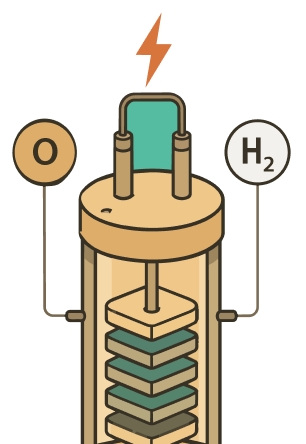
Electrolyser Technology

The core technology is an electrolyser, the first of which was invented in 1800 and commonly commercially used 100 years later. In recent years, there have been major advances in electrolyser technology but it is still expensive and produces energy at a higher cost than an equivalent unit of energy created by burning fossil fuels.

Blue Hydrogen

The other major form of “clean” hydrogen is “blue” hydrogen which is created by a process that coverts gas. However, it produces carbon dioxide which needs to be captured and stored underground. Again, despite recent advances, it is currently very expensive.

Alternate Production

Happily, there have been some interesting breakthroughs in non-electrolytic production of green hydrogen. “Gold” or “natural” hydrogen is an emerging industry, with promising results, that extracts hydrogen directly from underground sources.
02 / CHALLENGES

STORING AND TRANSPORTING HYDROGEN

The challenges of storing and transporting hydrogen adds high costs to its final price.

The Storage Problem

No matter how you make it, hydrogen is a very small molecule and is thus difficult to store and transport. It can be prone to escaping and is, in itself, a greenhouse gas.

Heavy Engineering

Storing it and transporting it thus requires heavy engineering, and those issues and costs increase exponentially if done in bulk.

Across Oceans

Indeed, for transport across oceans, it is often “cracked” (converted) to ammonia and then cracked back into hydrogen on landing. It can be mixed with gas and transported in specially engineered pipes and extracted from the gas at the point of reception.

Market Gap

All of these processes add costs to an already expensive molecule and the experience thus far is that the market, even with government support, is not prepared to pay the gap.

Promising Innovation

Again, happily, there has been some promising innovation in hydrogen storage and transport, a lot of it in Australia.

The challenge is not hydrogen. The challenge is the supply chain around it.

03 / CHALLENGES

USING HYDROGEN

Burning hydrogen to release its energy is wasteful and problematic – HERO® has solved this.
Orthodox Thinking

Burning Hydrogen

HERO® Approach

Flameless Heat

The Orthodox Use

At the end of this already expensive supply chain, the orthodox thinking about how to use hydrogen is to extract its energy by burning it.

HERO® Has Solved The Problem

HERO® has solved the problem by extracting the energy from hydrogen as heat, without a flame and conductively transferring it to the working medium.
04 / CHALLENGES

Regulating Hydrogen

Governments need to come to grips with the regulation of hydrogen, and particularly the way HERO® uses it.

Existing Assumptions

Governments need to come to grips with the regulation of hydrogen, and particularly the way HERO® uses it. Most of the safety regulations around hydrogen assume that it will be burned, just like any other gas.

HERO® Changes The Framework

However, HERO®’s unique way of extracting hydrogen’s energy, without a flame, has challenged regulators to provide a framework within which we can operate.

Regulatory Gaps

In some jurisdictions the regulation is adequate, in others it is inadequate or there are gaps.

Social Licence

For its social licence, hydrogen needs a workable regulatory framework within which to operate.
05 / CHALLENGES

SOVEREIGN AND GEOPOLITICAL RISK

For the already expensive orthodox fossil-fuel supply chain vision to work, it requires an operating environment free of external risk, a “perfect world”.

A Perfect World

For the already expensive orthodox fossil-fuel supply chain vision to work, it requires an operating environment free of external risk, a “prefect world”.

LONG, THIN SUPPLY CHAINS  

In the real world, this doesn’t happen. Whether it’s benign issues such as regulatory differences or major issues like weather or war, these long, thin supply chains can be easily disrupted, costing time and money.

THE PERFECT SUPPLY CHAIN

To be cost competitive and to reduce risk, the hydrogen supply chain needs to break away from orthodox thinking. 
The Way Forward

Star Scientific’s Solution

For HERO®’s beneficial impact on the supply chain to be fully amplified, we need to solve some of the other supply chain challenges, principally the costs.
For years, for anyone who has been listening, we have been saying that the expensive fossil-fuel supply chain vision for hydrogen won’t work. Now many critics have joined us.

The perfect supply chain is immediately local.

Made Locally

Cut transport costs and wastage by making hydrogen as close as we can to the user.

Stored Locally

Just-in-time production volumes will reduce costs and wastage.

Used Locally

Local production and use will massively reduce costs and wastage.
That means, the hydrogen is made locally on demand, stored in the locally required volumes and used where it is made. This will strip out many of the costs and risks.
To achieve this, we need companies like Star Scientific and universities to continue to innovate on technological improvements to the rest of the supply chain, particularly the creation and storage of clean hydrogen, and we need the continued support of governments for this innovation.
EXPLAINER VIDEO

Meet HERO® THE CATALYST FOR A NEW ENERGY ERA

Latest News

CHECK OUT THE LATEST STAR SCIENTIFIC NEWS

SUBSCRIBE TO OUR NEWSLETTER

For latest news & updates

Name
SUBSCRIBE TO OUR NEWSLETTER

For latest news & updates

Name